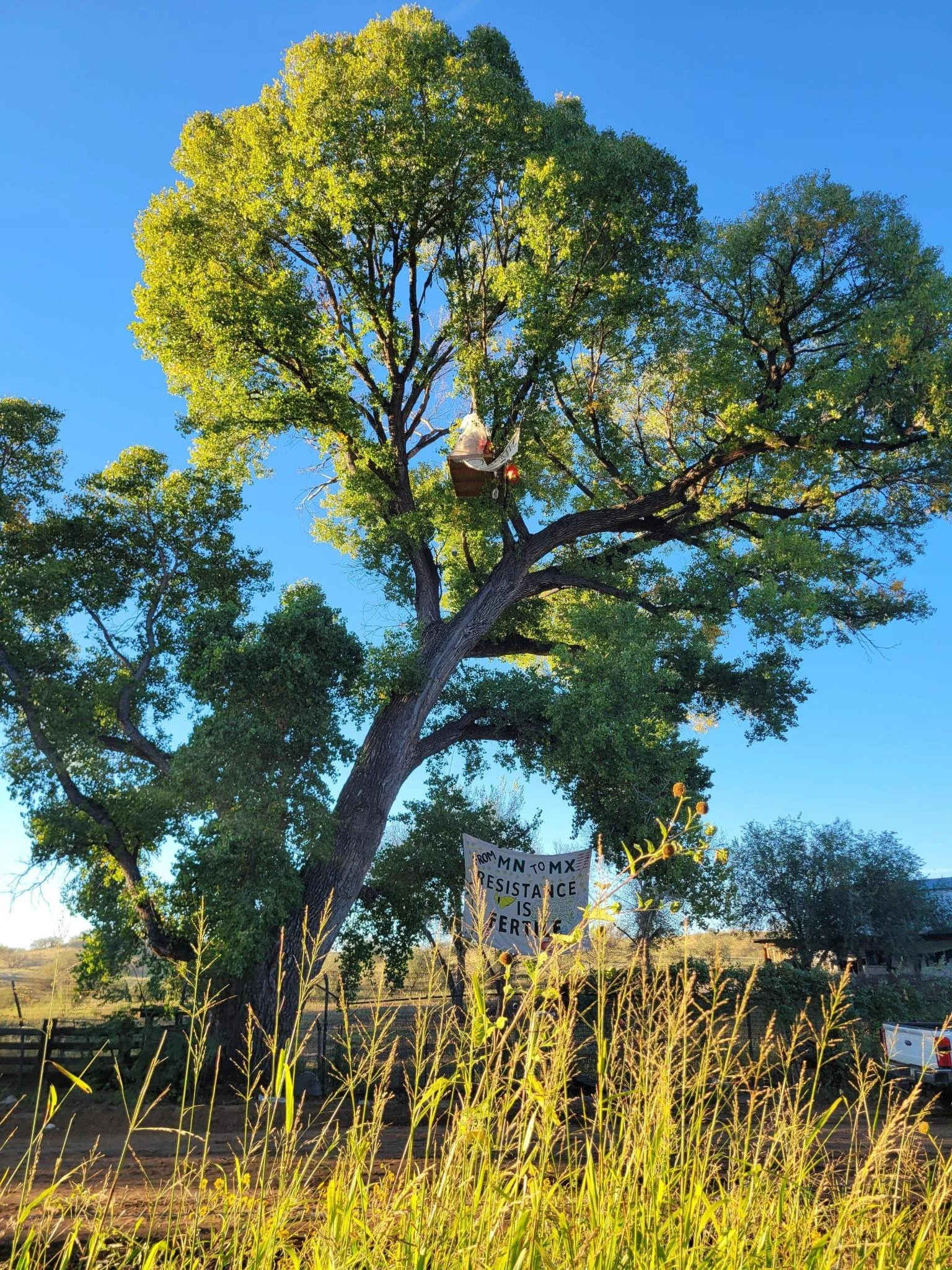
By sunrise Tuesday, federal agents had made arrests and yesterday’s tree sit was gone. But another land defender was already in the branches.
There is something almost too perfectly American about sending armed federal agents and construction crews into the desert to wage war against a tree.
But here we are.
Before sunrise Tuesday morning, October 6, a land defender climbed into the branches of the last remaining cottonwood tree in Tierra Libre standing in the path of border wall construction.
The tree is called Abuela.
She stands in La Noria, Sonora, Mexico, with her roots and branches straddling the imaginary line separating Mexico from the United States — a line that governments have spent billions of dollars trying to transform from an abstraction into steel, concrete, surveillance equipment and armed force.
Abuela has been here before.
On August 18, demonstrators occupied the tree in what organizers described as the first bi-national tree sit. Now someone is back in her branches, and construction has once again been halted.
This latest occupation comes after a brutal day at Tierra Libre.
On Monday, Border Patrol agents forcibly arrested 10 land defenders and cut down the Grandmother Tree sit, which had stood along the construction line for 71 days.
Seventy-one days is a long time to sit in a tree.
It is also a long time for a tree to stand between the federal government and something the federal government has decided must happen.
By Tuesday morning, the confrontation had begun again.
Border Patrol agents disrupted a sunrise ceremony and took two more land defenders into custody, according to organizers.
And still Abuela stood.
This is the peculiar mathematics of the borderlands: bulldozers, agents, arrests and enormous sums of government money on one side; a cottonwood tree and people willing to climb it on the other.
The imbalance is absurd. That is also the point.
A tree does not recognize an international boundary. Neither do its roots. Neither does water. Neither do birds, seeds, mountain lions or the ecological systems that existed here long before somebody drew a line across a map and eventually decided the line required a wall.
Abuela makes that contradiction embarrassingly visible. Her body occupies both sides at once.
And so the machinery stops.
For now.
“We stand strong and will not be deterred by state violence or intimidation,” a land defender on the ground at Tierra Libre said Tuesday morning. “We call on all people of ceremony, all people of conscience, to come join us now in La Noria and Lochiel, to protect the land, to protect the sacred.”
There is no way to know how long this tree sit will last.
The government has machinery. It has agents. It has detention cells. It has the enormous institutional patience of a bureaucracy convinced that eventually everything standing in its way can be removed.
The people at Tierra Libre have something else: the willingness to return.
Monday, a tree sit that had survived 71 days was destroyed.
Tuesday morning, somebody climbed another tree.
That is the part worth remembering.
Because somewhere along the border, while most of the country was still asleep, somebody looked at the machinery coming toward a cottonwood tree, looked at what had happened the day before, and climbed anyway.
And once again, the bulldozers stopped.